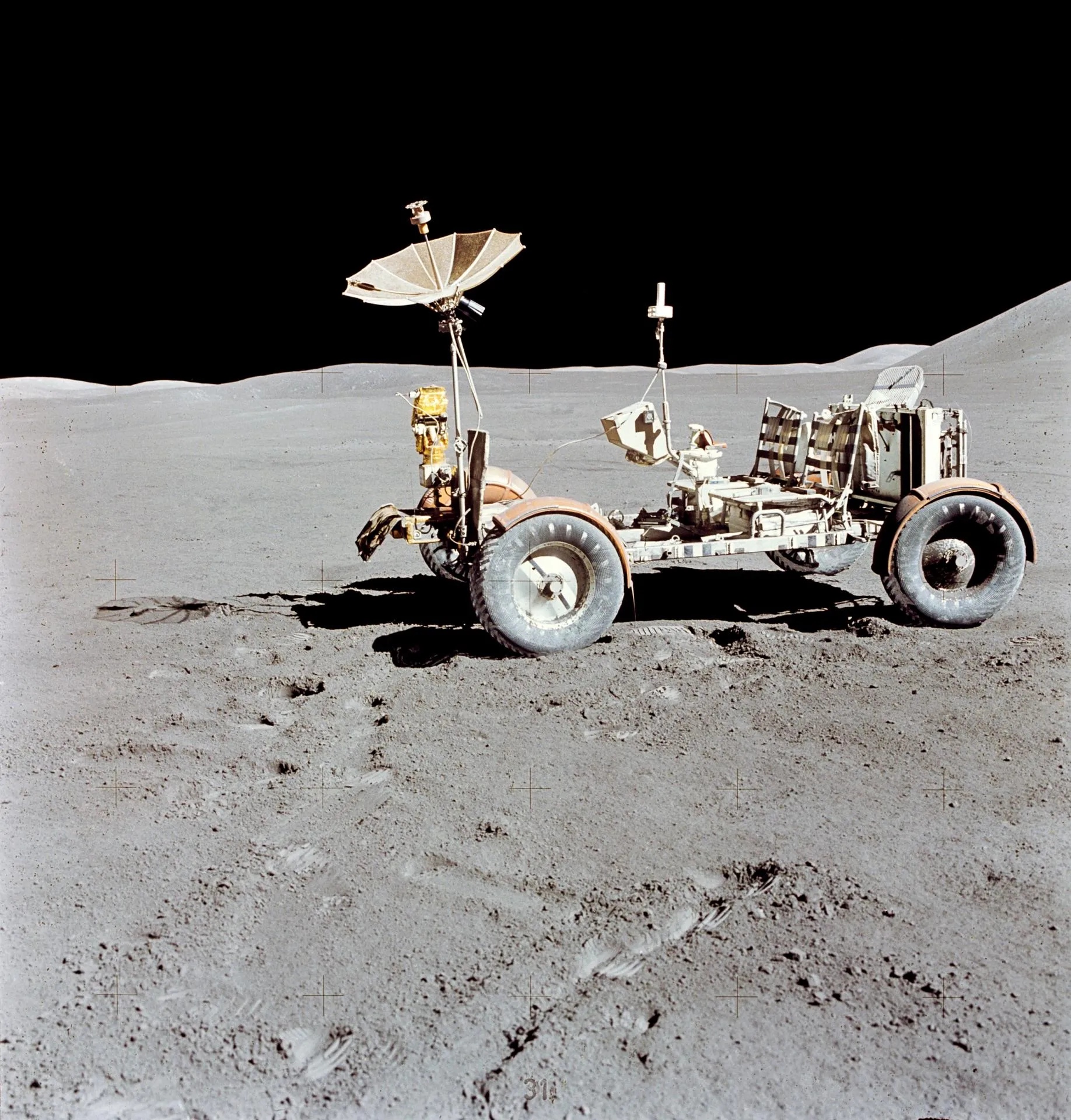
First landing: 30 July 1971Status: Not working any more
Lunar Roving Vehicles
Image: NASA (JSC)
Main spot on the Moon:Hadley–Apennine
Each rover carried two astronauts, their tools and the rocks they collected. The rovers were driven 27.8 km on Apollo 15, 26.7 km on Apollo 16 and 35.9 km on Apollo 17.
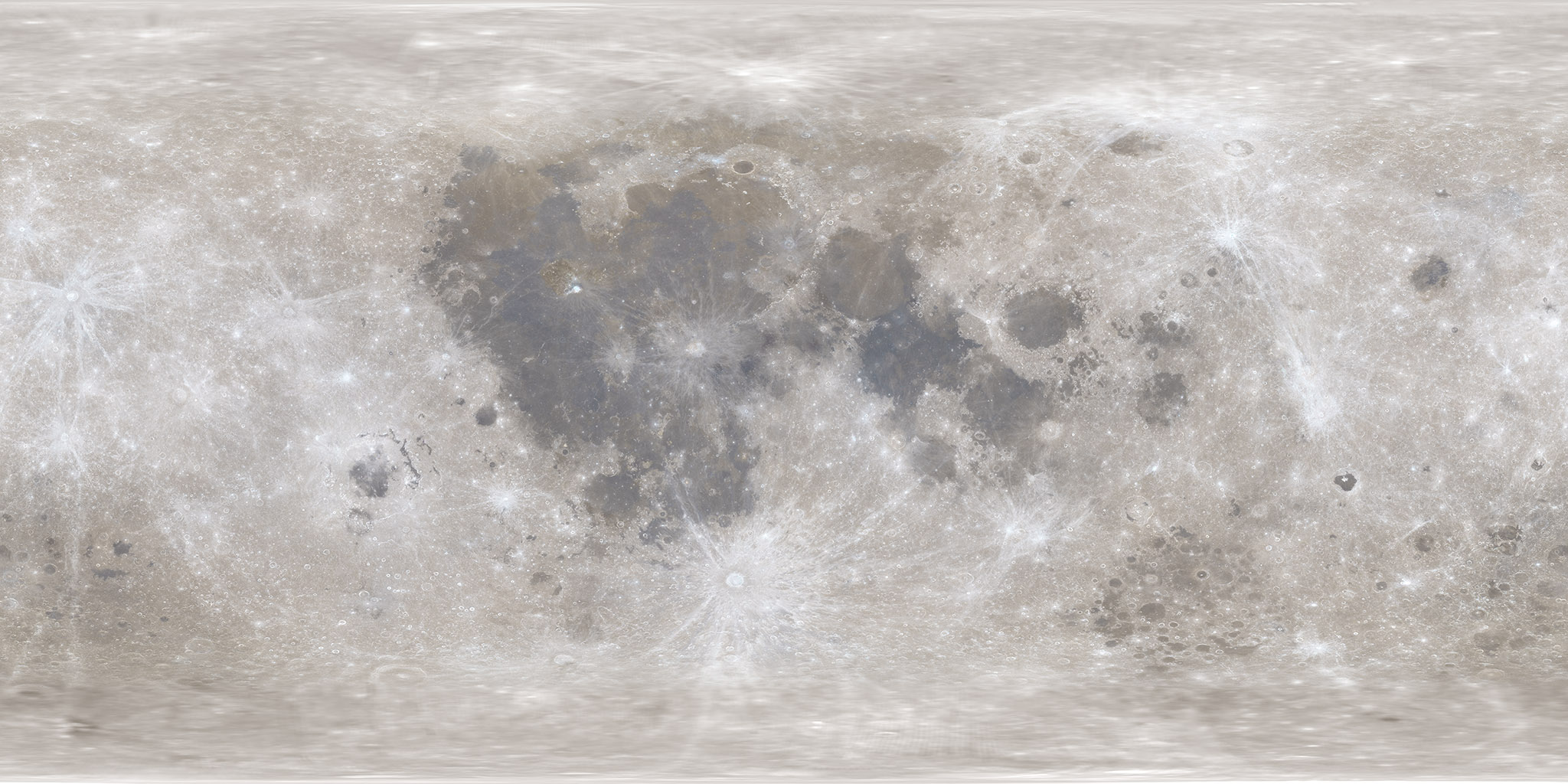
What did the rovers leave behind?
Walking on the Moon sounds exciting. But imagine trying to explore a huge, unfamiliar landscape on foot: wearing a spacesuit, carrying equipment, and working with limited time. The Apollo astronauts faced exactly that problem.

Echo: Hi! Buckle up, we're going for a drive on the Moon.
The idea
A car for the Moon
The early Moon missions showed that astronauts could walk, collect rocks and set up experiments. But if they wanted to explore much farther from their Lunar Module, walking wasn't the best solution.
So NASA came up with something very different: a car for the Moon.
The Lunar Roving Vehicle, or LRV, was a small electric vehicle designed specifically for the Moon. It could carry two astronauts, scientific equipment and other supplies, allowing them to travel much farther across the lunar surface than they could on foot.
But the Moon has no roads, and the LRV couldn't simply be driven there like an ordinary car.
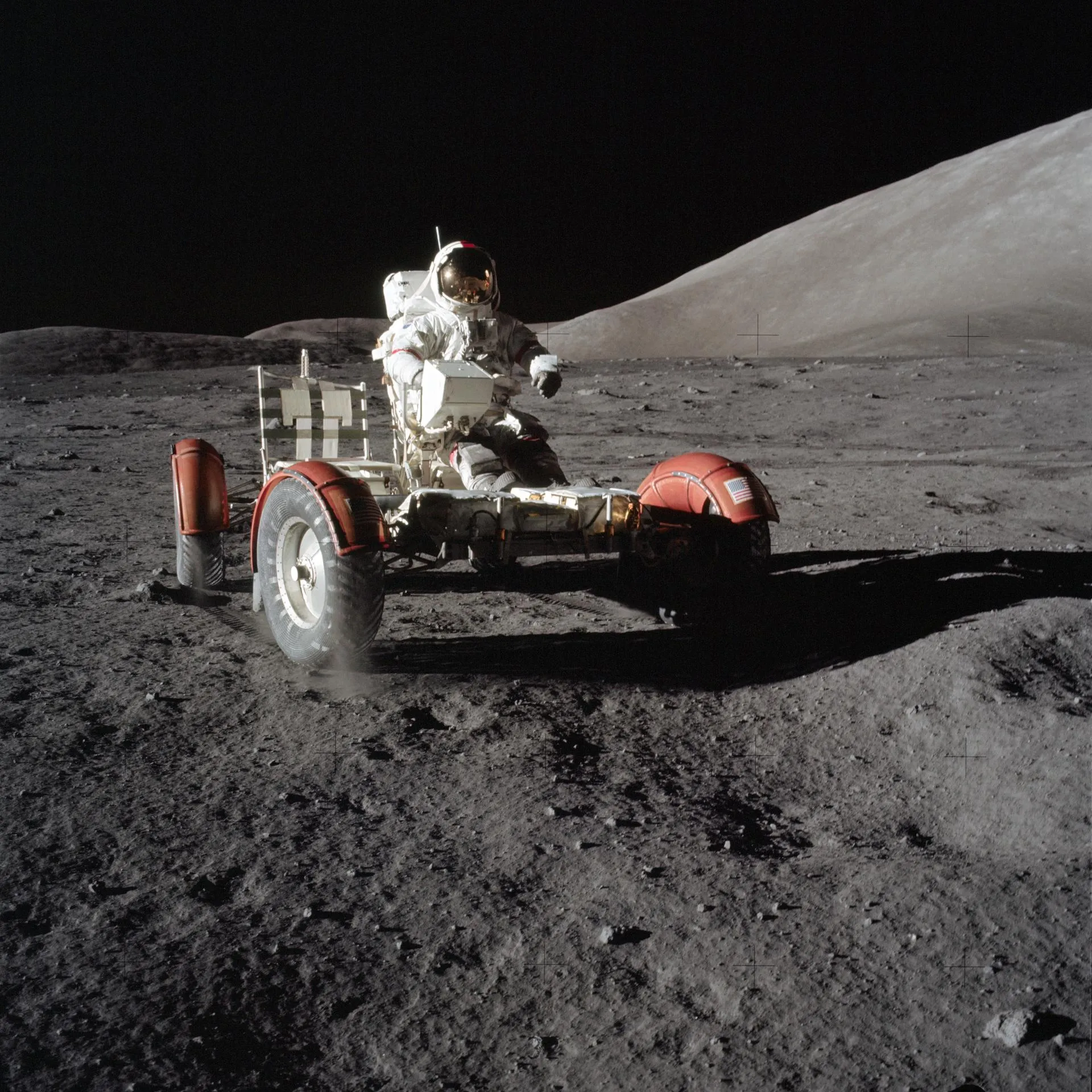 (opens larger view)
Apollo 17 Eugene Cernan takes the Apollo 17 rover for a short test drive, before the crew loads it up with cameras, antennas and tools.
Image: JSC
Built for the Moon
The rover weighed only 210 kg, but it could carry 490 kg more: two astronauts, their tools and their rocks. Each of its four wheels had its own electric motor, and the tyres were made of woven steel wire instead of rubber.

Echo: Tyres made of woven steel wire. No rubber at all!
By the numbers
Three rovers, three road trips
- rovers driven on the Moon, on Apollo 15, 16 and 17
- 3
- what one rover weighed on Earth
- 210 kg
- driven by the Apollo 17 rover, the farthest of the three
- 35.9 km
- the farthest any rover got from its Lunar Module
- 7.6 km
Apollo 15 · July 1971
Packed for the trip
The first LRV was taken to the Moon on Apollo 15, which landed on 30 July 1971. Apollo 15 was the fourth Apollo mission to successfully land astronauts on the Moon, but it introduced several new technologies, including the Lunar Roving Vehicle.
The rover travelled folded up, tucked into a storage bay in the lower half of the Lunar Module. Once the astronauts were ready to use it, they lowered it out with ropes and tapes, and it unfolded itself almost automatically as it came down.
Then they could climb into the two seats, switch it on and drive across the Moon.
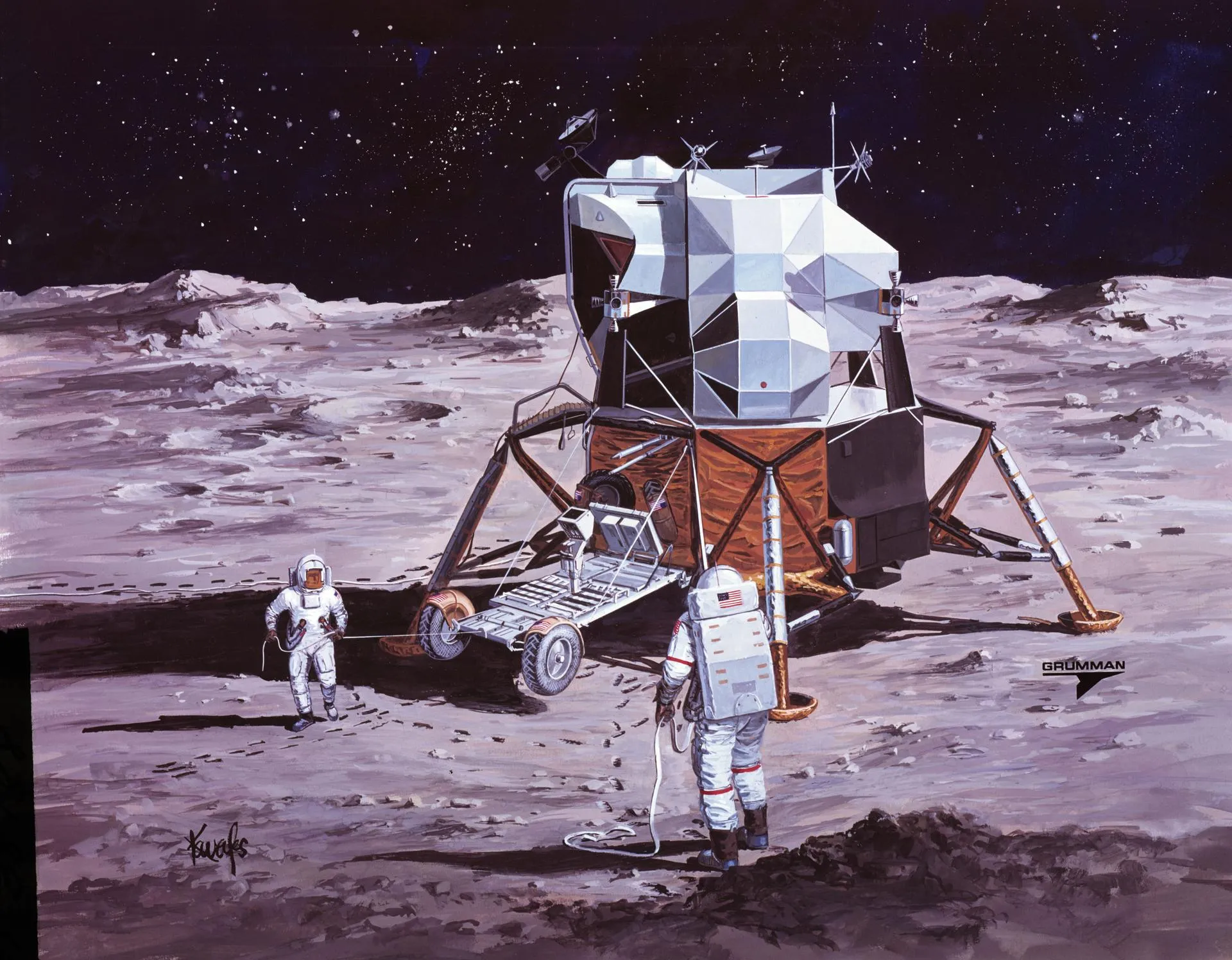 (opens larger view)
Illustration: how the Apollo 15 crew would lower the rover from the side of the lander. One pulls a cable to help it unfold, the other pulls the tapes that let it down.
Image: JSC

Echo: A car that unfolds itself? That's one cool trick.

Imagine this…
You've just unfolded a car on the Moon. There are no roads, no signs and no map app on your phone. How would you find your way back to your spacecraft?
Apollo 15 · Hadley–Apennine
And it really could travel
During Apollo 15, astronauts David Scott and James Irwin drove the rover more than 27 kilometres in total. They explored the Hadley–Apennine region, travelled to different geological sites and collected rocks and soil along the way.
The rover allowed them to reach places that would have been much harder to visit on foot.
But Apollo 15 was only the beginning.
The first lunar rover worked without any major problems. That meant the next missions could make even greater use of it.
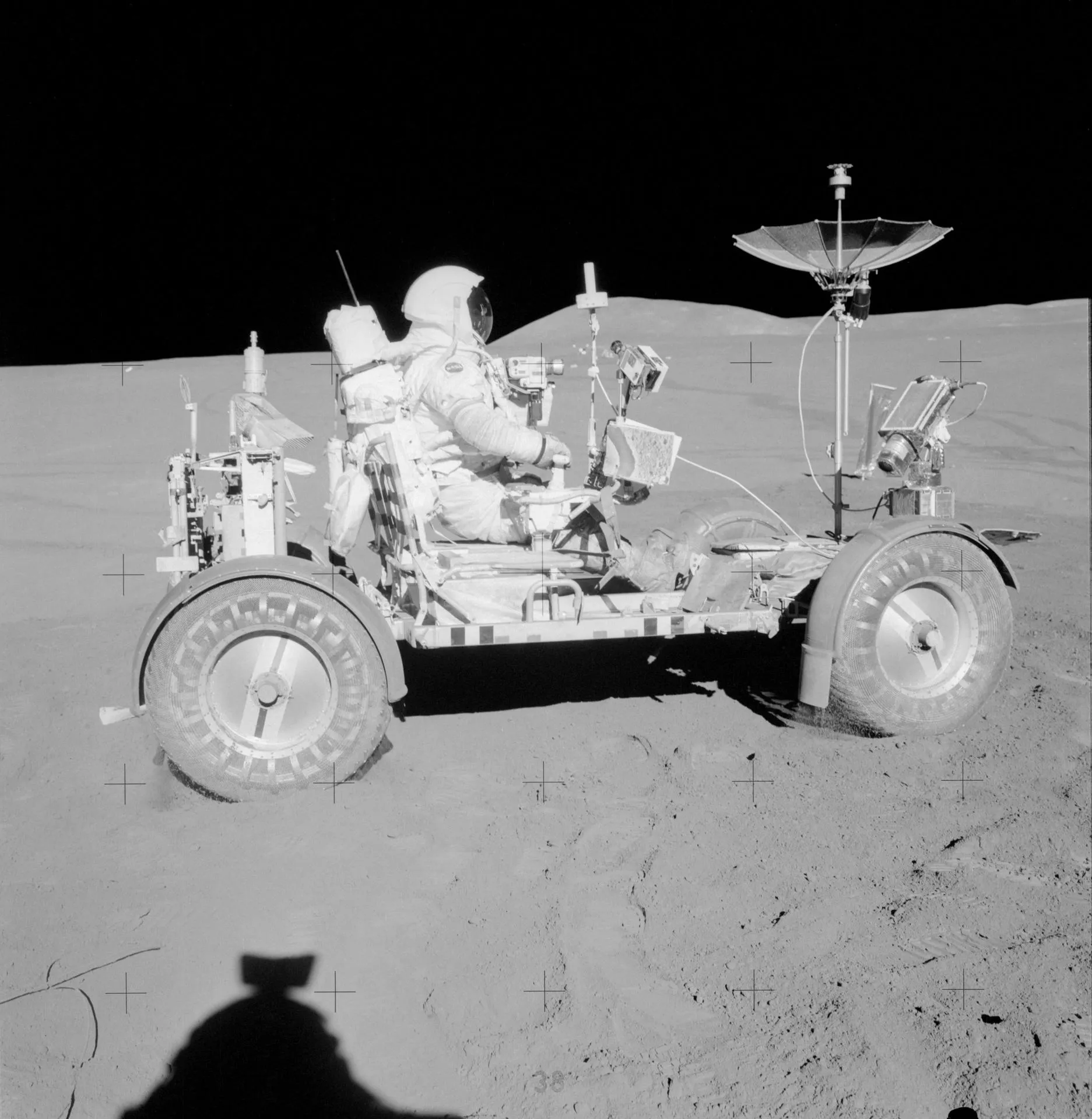 (opens larger view)
Apollo 15 David Scott in the rover on the first Apollo 15 moonwalk. James Irwin took the picture.
Image: NASA (JSC)
How did they find the way home?
The rover had its own navigation computer. A gyroscope tracked which way it was heading and a counter measured how far the wheels had turned, so the computer always knew the direction and distance back to the Lunar Module.

Echo: No phone, no map app, just a clever little computer!
Apollo 16 · April 1972
The second rover
Apollo 16 landed in April 1972 and carried the second Lunar Roving Vehicle.
Astronauts John Young and Charles Duke used it to explore the lunar surface in the Descartes highlands and travel between scientific sites.
By the end of the mission, they had driven about 26.7 kilometres.
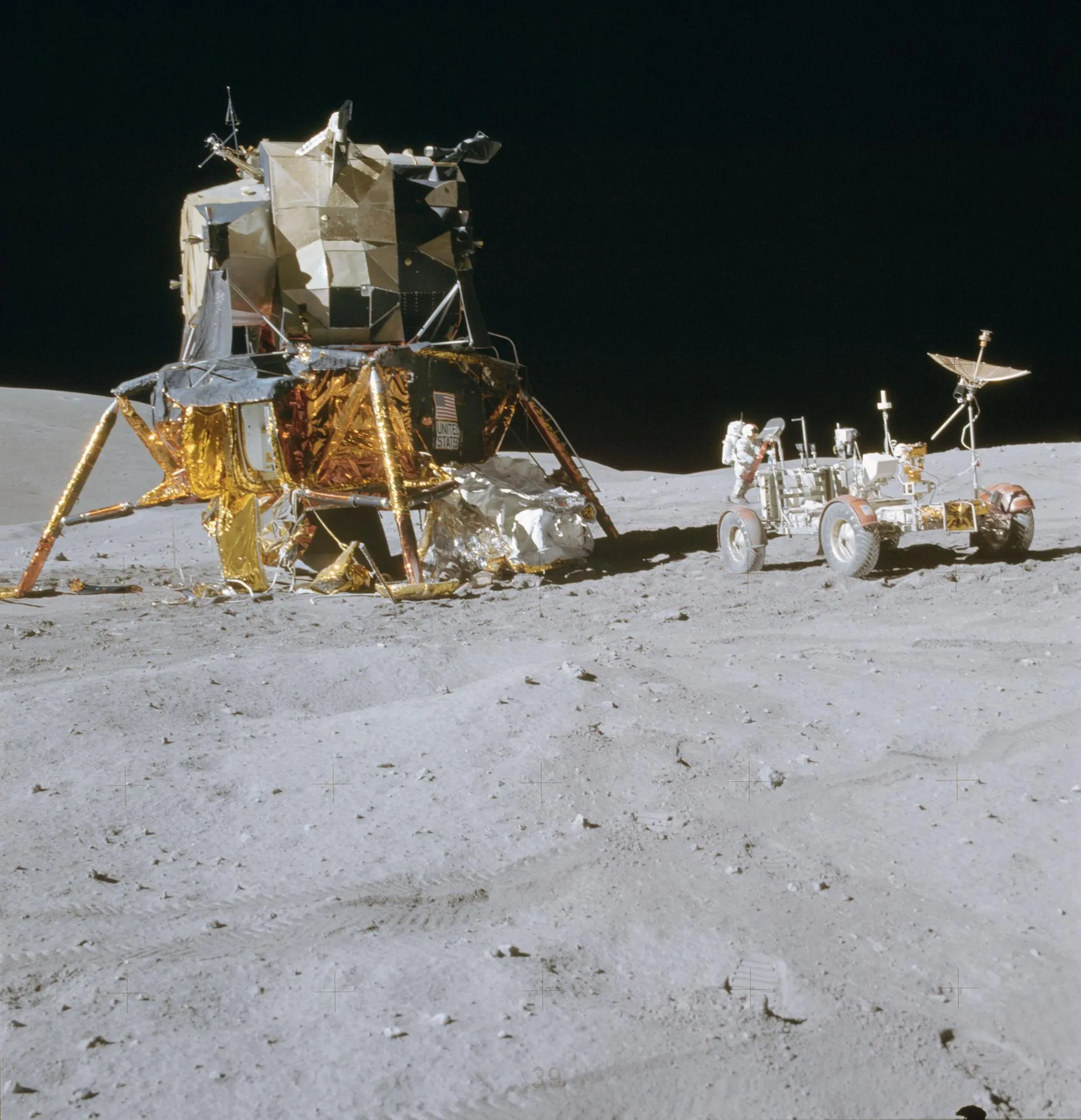 (opens larger view)
The Apollo 16 rover next to the lander Orion, on the first moonwalk. John Young stands just behind the rover.
Image: JSC
Apollo 17 · December 1972
The longest drive
Then came Apollo 17, the final Apollo mission to land humans on the Moon.
Its astronauts, Gene Cernan and Harrison Schmitt, had the third and final LRV used on the Moon.
This time, the rover travelled even farther: about 35.9 kilometres in total. Its longest single trip was about 20.1 kilometres, and it reached as far as 7.6 kilometres from the Lunar Module.
By now, the Moon was no longer a place astronauts could only explore a short distance around their landing site. With the LRV, they could drive across the lunar landscape, stop at interesting locations, collect samples and reach places that would have taken far longer to reach on foot.
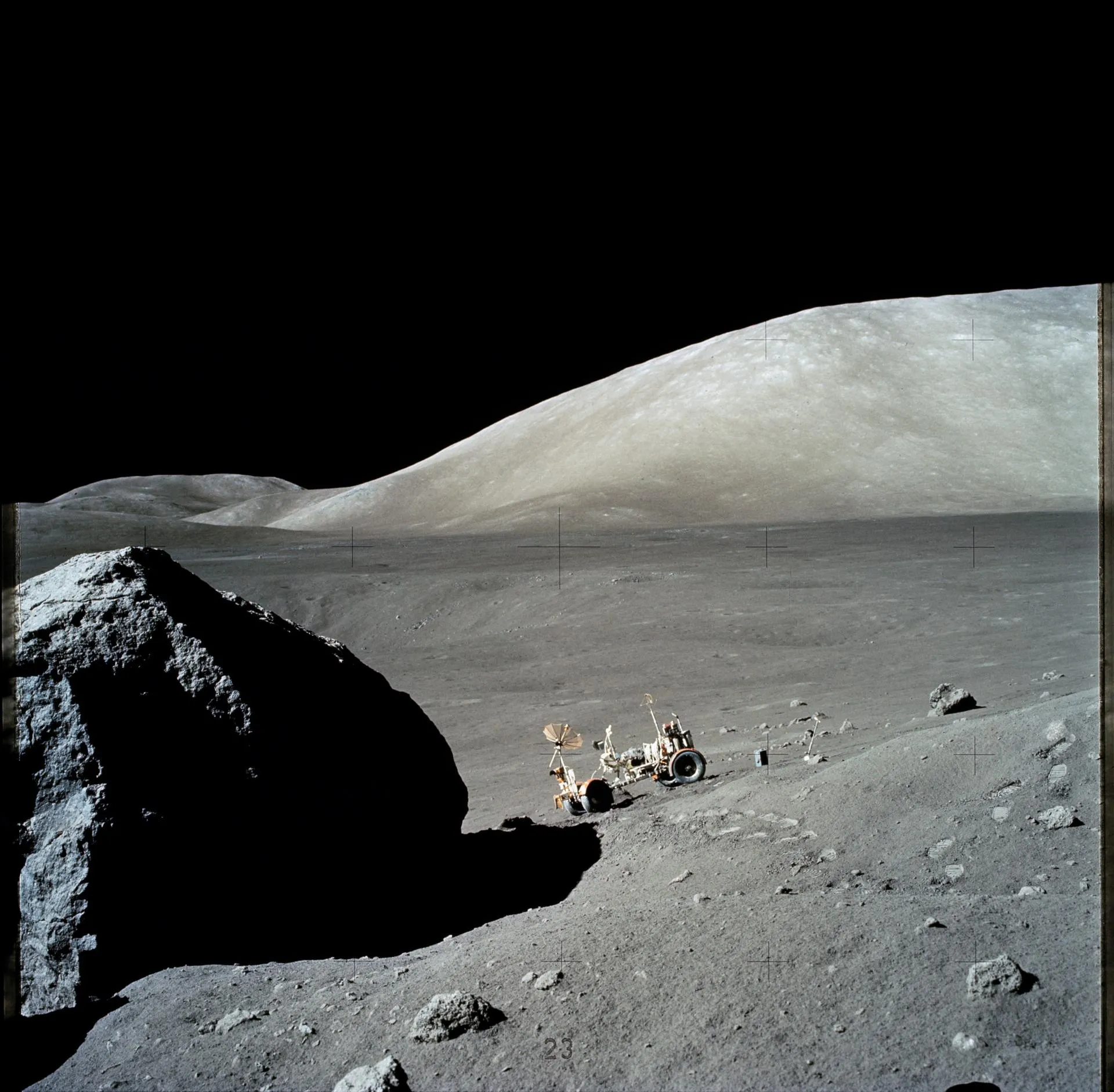 (opens larger view)
Apollo 17 The Apollo 17 rover beside a giant boulder on the third moonwalk.
Image: NASA (JSC)
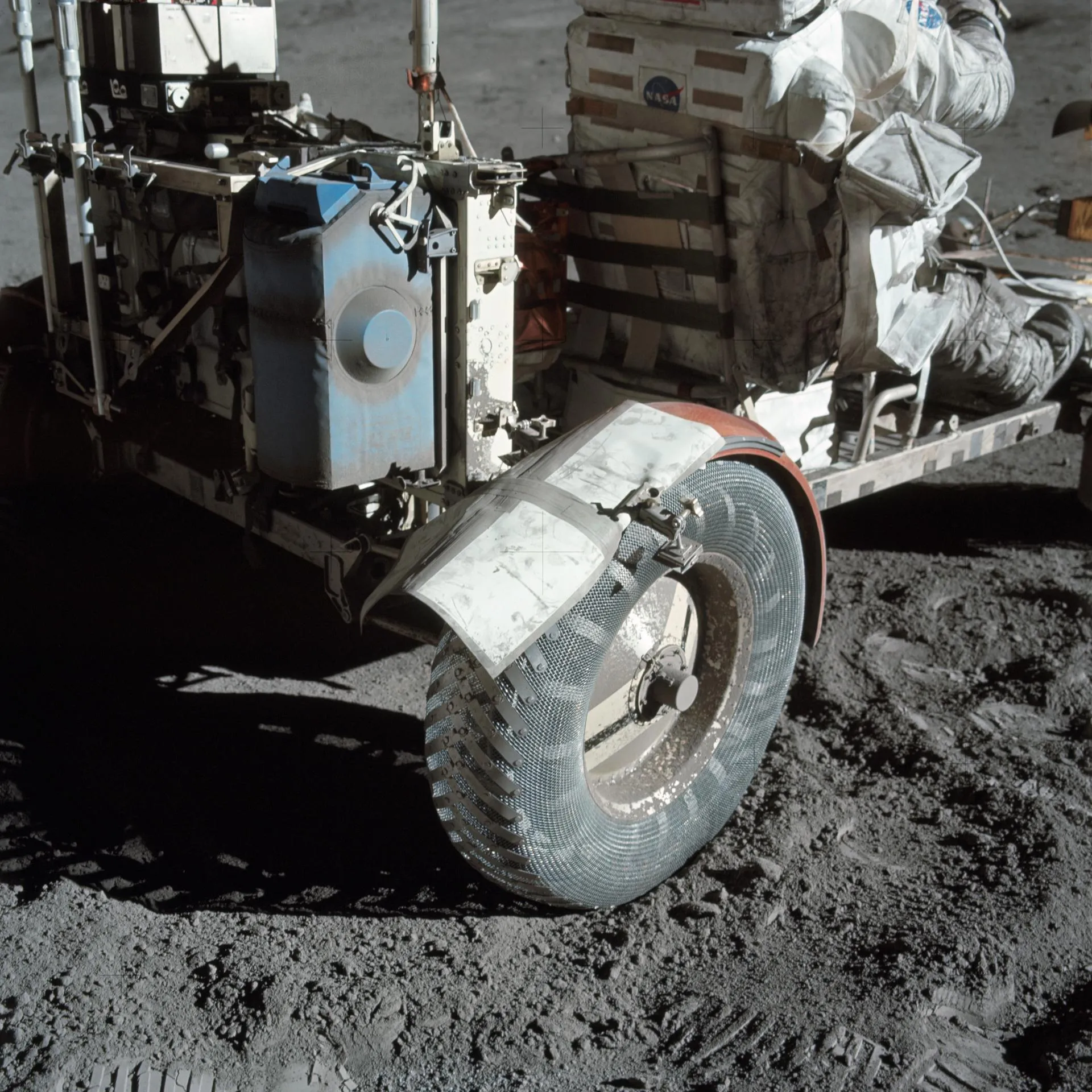
A repair with maps and clamps
On the first moonwalk, a hammer caught under one of the rover's fenders and knocked part of it off. Without it, the wheel sprayed dust everywhere. Following a tip from Mission Control, the astronauts made a new fender out of lunar maps and clamps from a lamp.

Echo: The longest Apollo road trip, and they fixed their own car on the way!
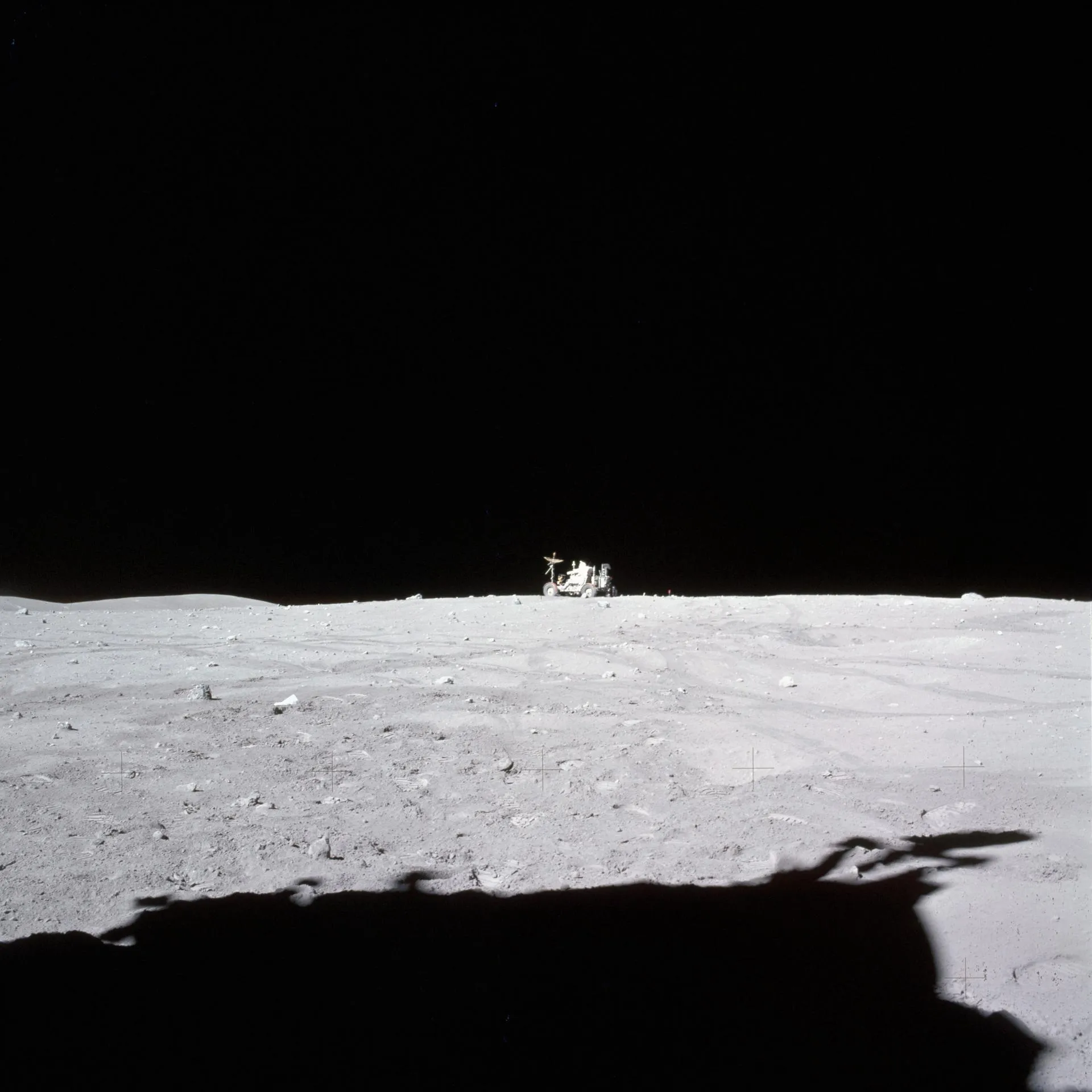
And then, just like the other Apollo hardware…
the rover was left behind.
Image: NASA (JSC)
Parked for good
The last drive
The astronauts drove each LRV to its final parking place before they left the Moon. Apollo 15's rover was parked about 160 metres from its Lunar Module, while the Apollo 16 and Apollo 17 rovers were parked about 81 and 158 metres away.
From its parking spot, each rover had a front-row seat. Its colour TV camera, steered by remote control from Mission Control in Houston, filmed the Lunar Module's top half blasting off, so people on Earth could watch.
The astronauts went home.
The rovers stayed.
And their tracks stayed too.
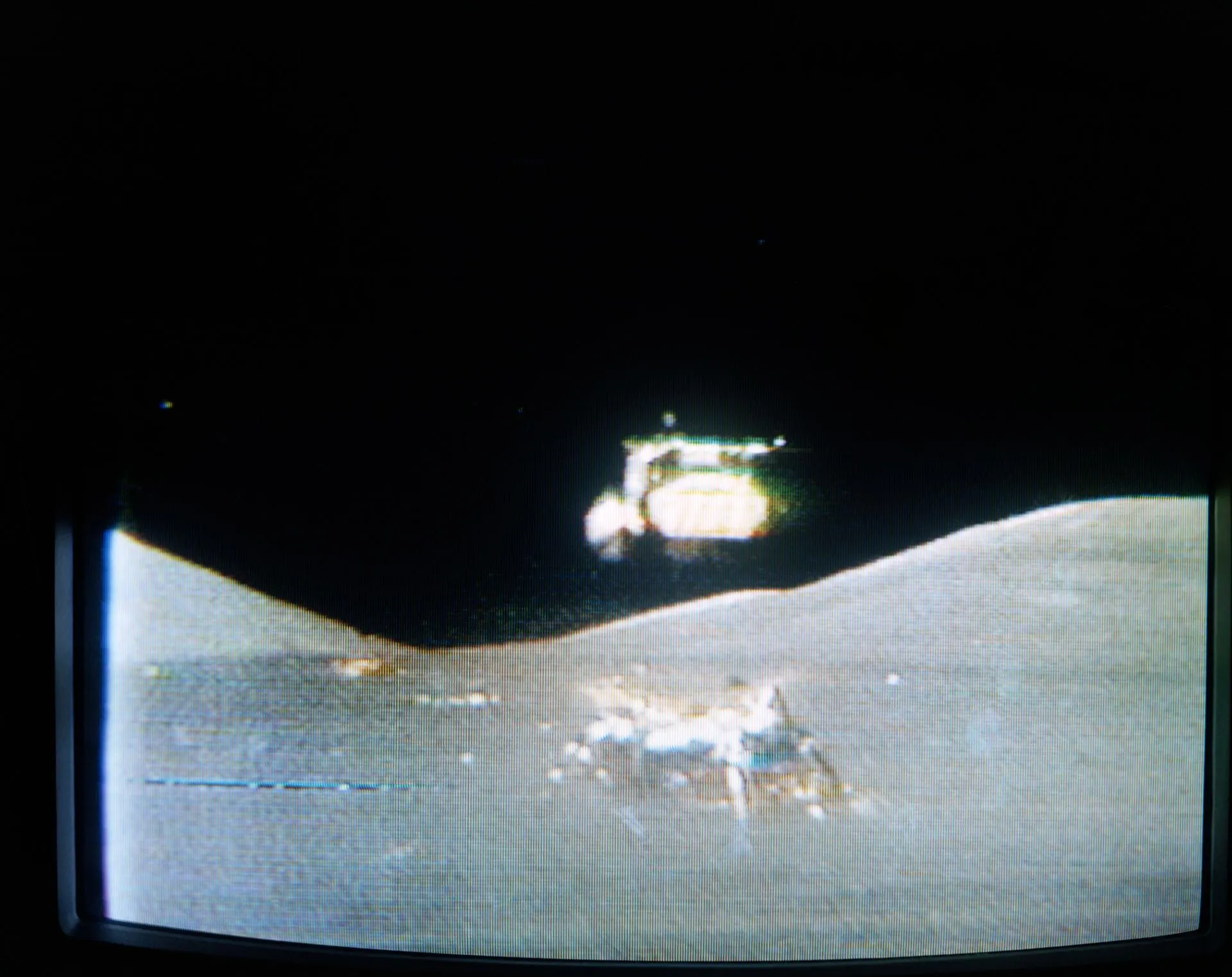 (opens larger view)
Apollo 17 liftoff The Apollo 17 rover's TV camera films Challenger's ascent stage heading for the sky, 14 December 1972.
Image: NASA (JSC)

Echo: Best seat in the house for the liftoff!
In pictures
Life with a Moon car
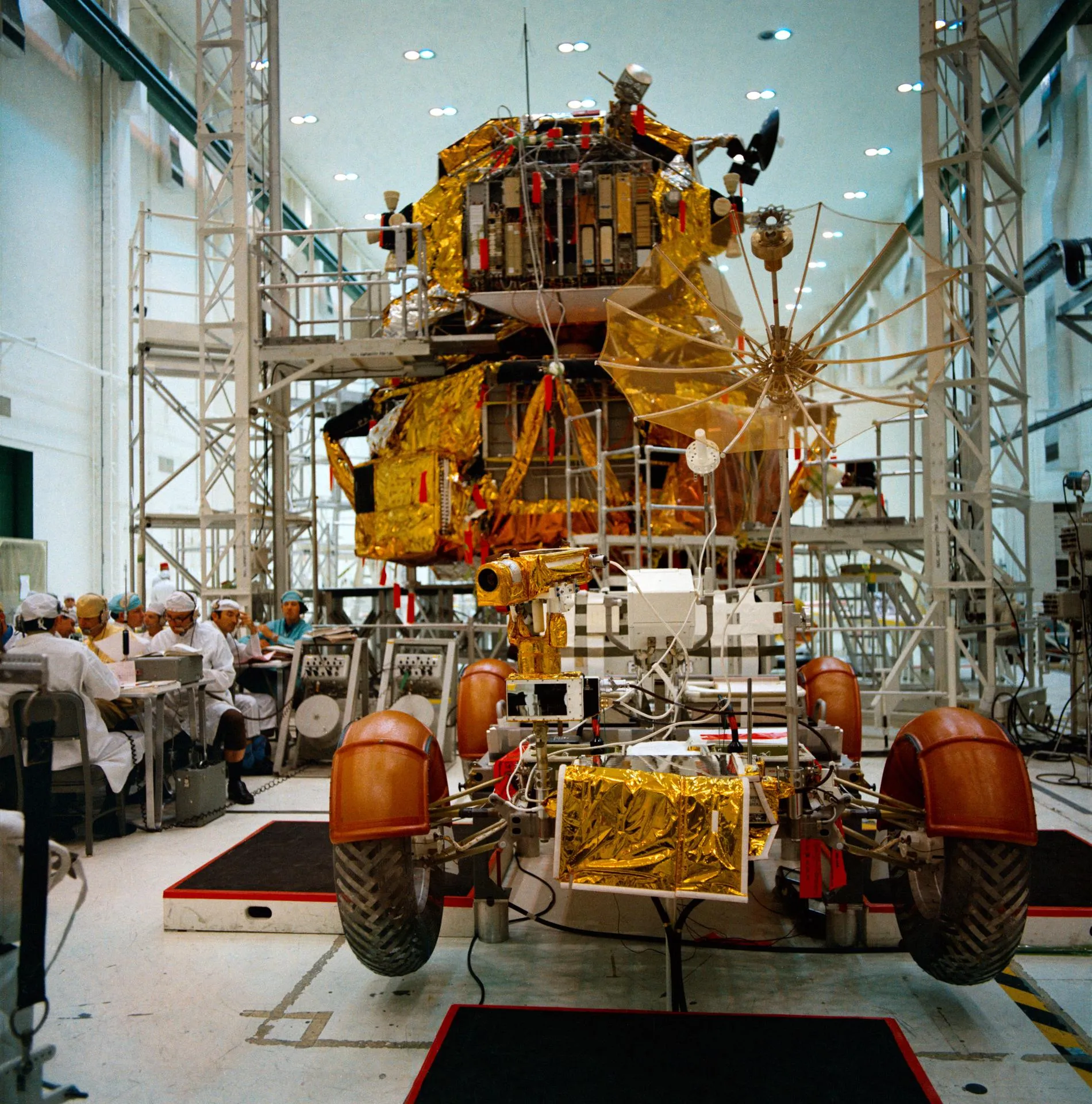 (opens larger view)
Before the trip: the Apollo 15 rover and Lunar Module during practice runs at the Kennedy Space Center, April 1971.
Image: JSC
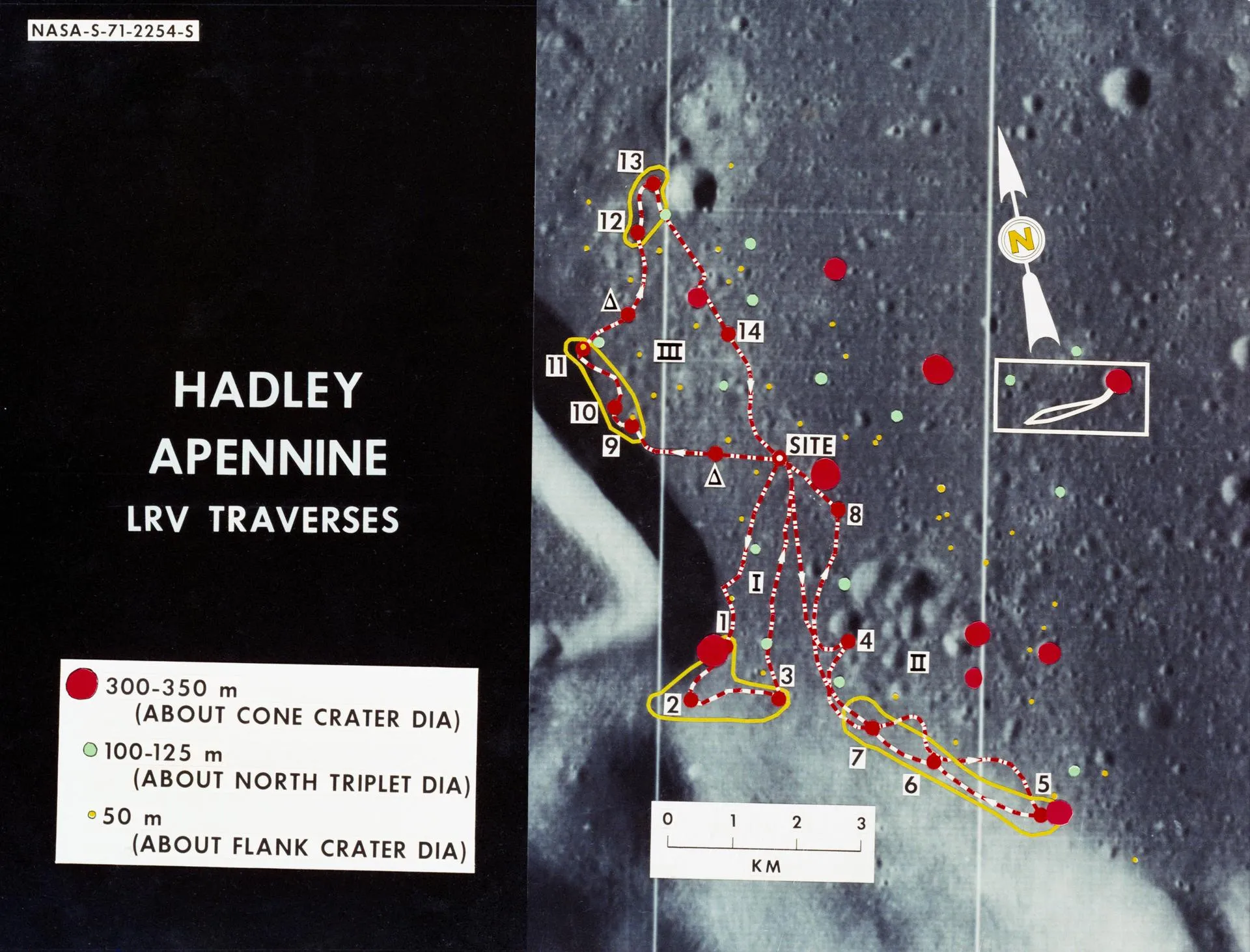 (opens larger view)
The planned rover routes for Apollo 15, drawn on a photo taken from lunar orbit.
Image: NASA (JSC)
 (opens larger view)
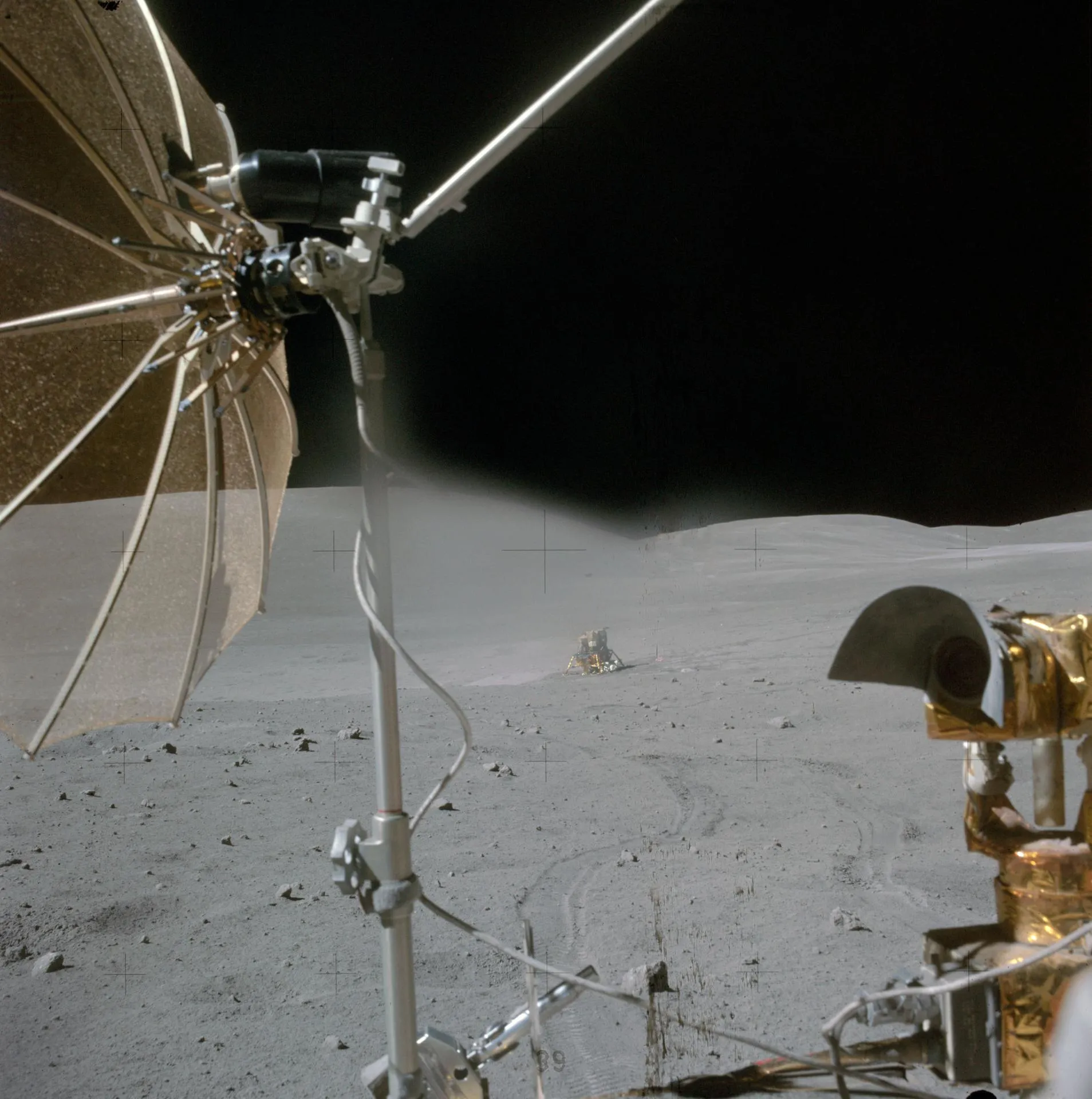
Heading "home": the Apollo 16 lander Orion, seen from the moving rover at the end of the last moonwalk.
Image: NASA (JSC)
 (opens larger view)
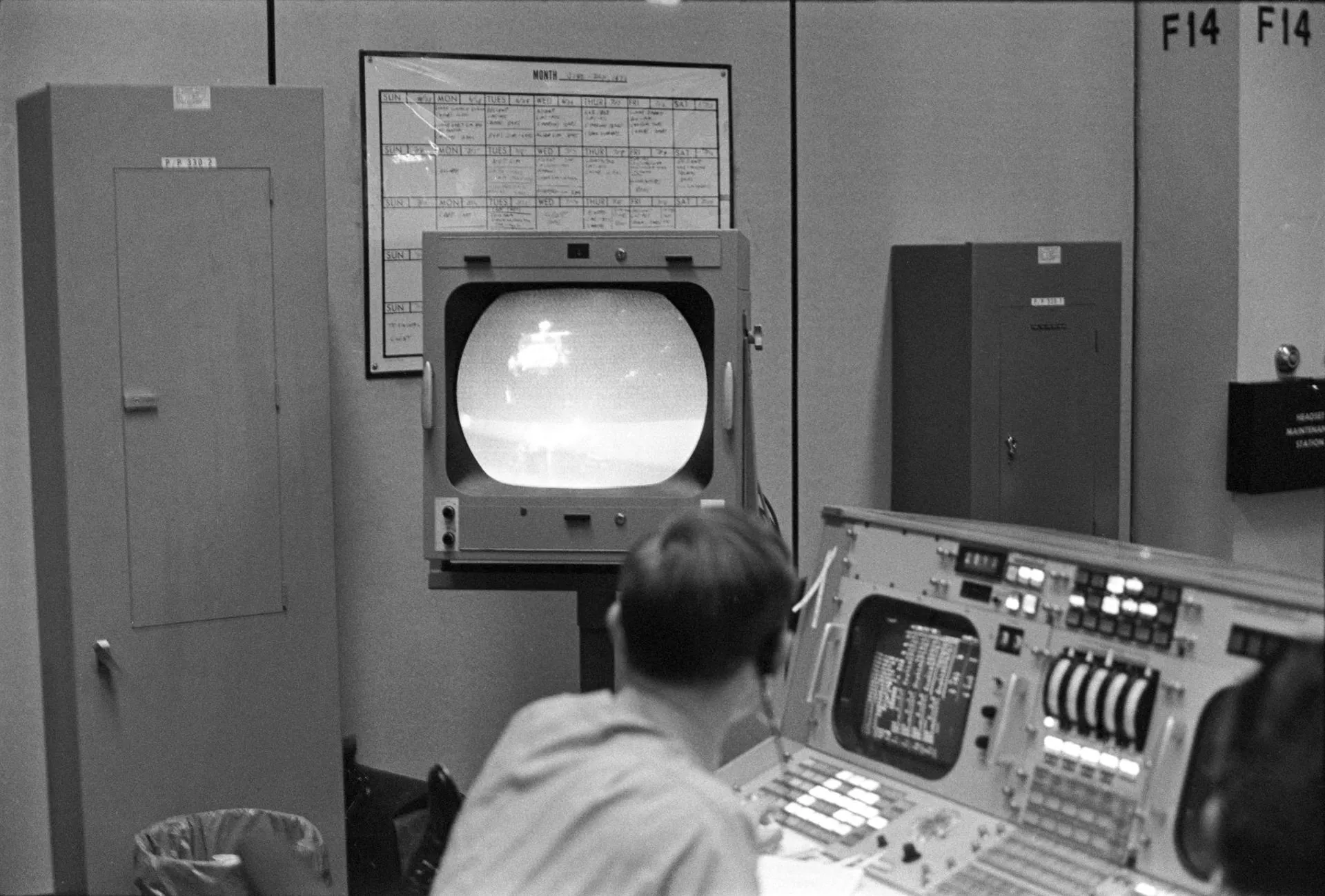
In Mission Control, the Apollo 15 liftoff appears on a TV screen, sent live from the camera on the parked rover.
Image: NASA (JSC)
Seen from orbit
Tracks you can see from space
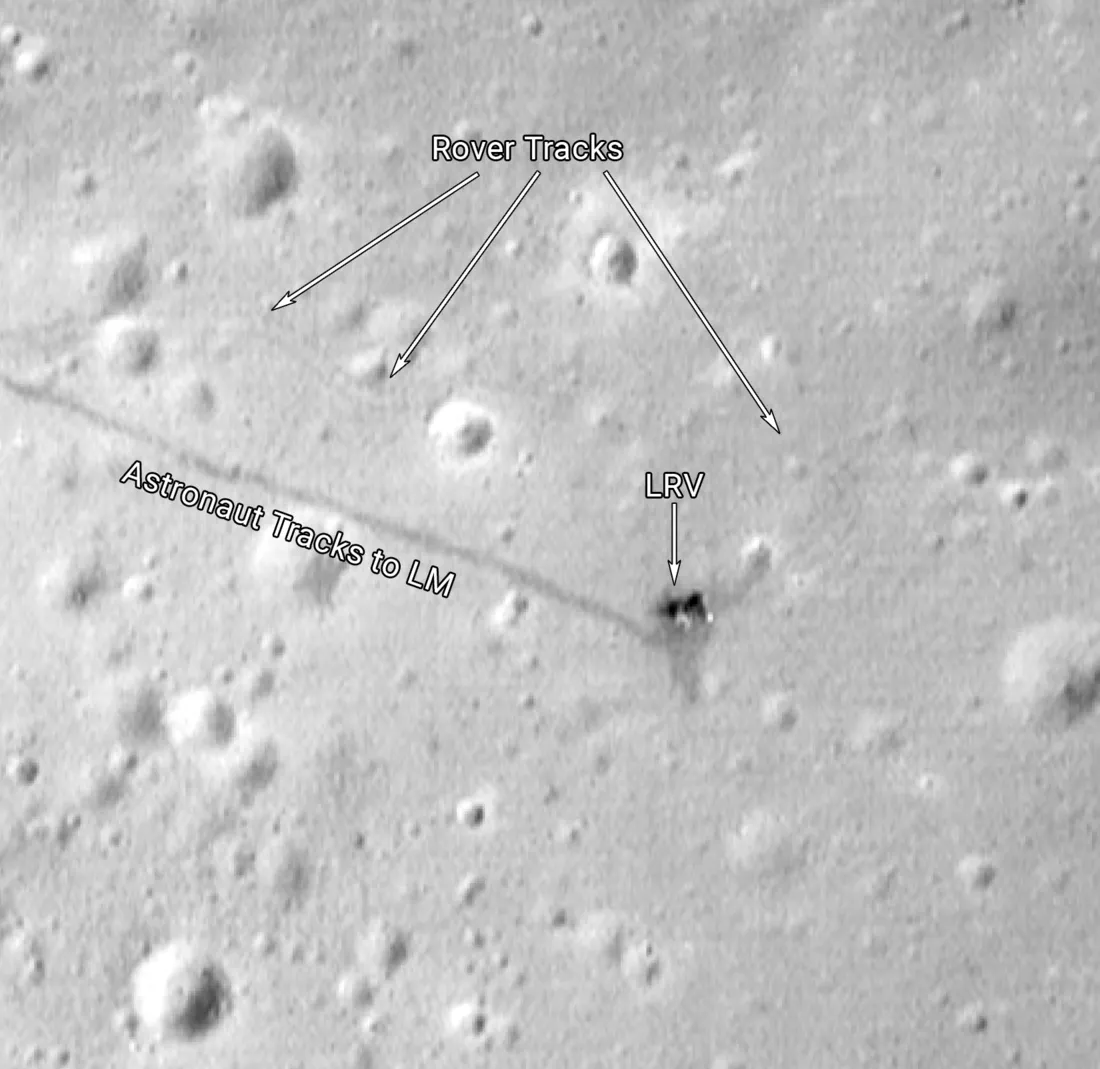
Decades later, NASA's Lunar Reconnaissance Orbiter photographed the Apollo landing sites from orbit.
In the images, scientists can still see the Lunar Roving Vehicles and the trails they made across the Moon's surface.
At the Apollo 15 site, for example, the rover and its tracks can be seen in images taken from orbit, right where Dave Scott parked it.
 (opens larger view)
The Apollo 15 rover at its final parking spot, photographed by NASA's Lunar Reconnaissance Orbiter. You can see the rover's tracks and David Scott's footprints leading back to the lander.

Echo: Tyre tracks, spotted from space!
Timeline
Three rovers, from the first drive to the last
30 July 1971
Apollo 15 lands
The Lunar Module Falcon brings the first rover, folded up in a storage bay.
31 July 1971
The first drive on the Moon
On the first Apollo 15 moonwalk, David Scott and James Irwin set off in the rover.
2 August 1971
Apollo 15 leaves
The parked rover's TV camera sends pictures of the liftoff back to Mission Control.
21 April 1972
Apollo 16 lands
John Young and Charles Duke bring the second rover to the Descartes highlands.
23 April 1972
The second rover is parked
Young drives it to its final parking place near the end of the last moonwalk.
11 December 1972
Apollo 17 lands
Gene Cernan gives the third rover a short test drive before loading it up.
12 December 1972
The fender fix
Early on the second moonwalk, the crew repairs the broken fender with maps and clamps.
14 December 1972
The last liftoff
The Apollo 17 rover's camera films Challenger leaving. All three rovers stay on the Moon.
June 2009
LRO arrives
NASA's Lunar Reconnaissance Orbiter reaches the Moon. Its camera later spots the rovers from orbit.
…the Lunar Rover proved to be the reliable, safe and flexible lunar exploration vehicle we expected it to be. Without it, the major scientific discoveries of Apollo 15, 16, and 17 would not have been possible.
What we learned
More than just Moon cars
The Lunar Roving Vehicles were more than just Moon cars.
They changed what astronauts could do on the lunar surface. Instead of being limited to the area around their landing spacecraft, they could travel farther, explore more ground and bring back more clues about the Moon.
And today, those little electric vehicles are still sitting where the astronauts left them.
Quiet reminders of the first time humans drove on another world.
More clues to bring home
On foot, the Apollo 11 crew collected about 21.5 kg of Moon rock and soil. With their rovers, the last three crews brought back 77 kg, 96 kg and 111 kg.

Echo: Three cars, parked on the Moon for more than 50 years. Not forgotten!
Still there today
Three rovers, three parking spots
- Status: Not working any more
Apollo 15 rover
Parked about 160 m east of the lander, where NASA's Lunar Reconnaissance Orbiter can still see it.
- Status: Not working any more
Apollo 16 rover
Its three trips were 4.2 km, 11.1 km and 11.4 km long. Parked less than 100 m east of the lander.
- Status: Not working any more
Apollo 17 rover
Unpacked and driven on the first moonwalk of the last Apollo landing. Parked about 160 m east of the lander.
Sources and fact-check
- NASA Space Apps Challenge 2026: Abandoned but not Forgotten (mission list)
- NSSDCA: Apollo 15 Lunar Module / ALSEP
- NSSDCA: Apollo 16 Lunar Module / ALSEP
- NSSDCA: Apollo 17 Lunar Module / ALSEP
- NSSDCA: Apollo 11 Lunar Module / EASEP
- NSSDCA: The Apollo Lunar Roving Vehicle
- LROC: Apollo 15: A Mission of Many Firsts
- NASA History: 15 Years Ago: Lunar Reconnaissance Orbiter Begins Moon Mapping Mission
- Apollo Lunar Surface Journal: Final LRV parking places (E. M. Jones, 2005)
- NASA: Apollo 17
- NASA Image: Apollo 17 rover with the makeshift fender repair (AS17-137-20979)
- NASA Image: Apollo 17 liftoff seen by the rover's TV camera (S72-55421)
- NASA Image: Scott seated in the rover, first Apollo 15 EVA (AS15-85-11471)
- NASA Image: Young drives the rover to its final parking place (AS16-115-18559)